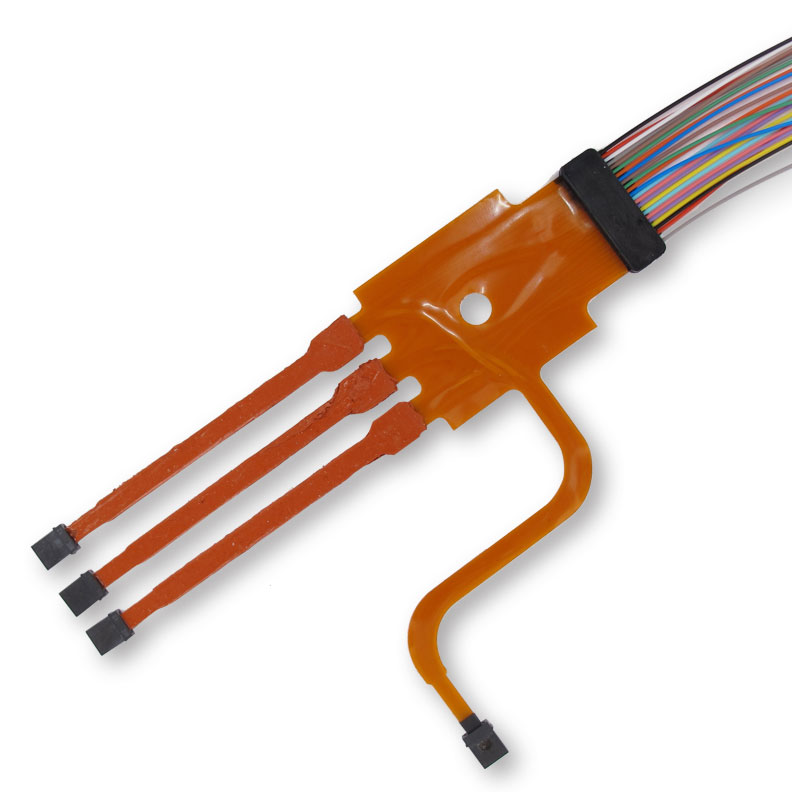
Fiber Optic Flex Circuits are advanced, flexible interconnect solutions that integrate optical fibers into a compact, lightweight, and highly durable circuit design. These circuits are engineered to transmit data using light signals, offering significant advantages over traditional electrical wiring, such as higher bandwidth, faster data transmission speeds, and immunity to electromagnetic interference (EMI). This makes them ideal for applications where performance, reliability, and space efficiency are critical.
Key Features and Benefits:
High-Density Connectivity:
Fiber optic flex circuits can accommodate a large number of optical fibers in a compact form factor, enabling high-density interconnections in space-constrained environments. This is particularly valuable in industries like aerospace, defense, and telecommunications, where minimizing weight and size is essential.Durability in Harsh Environments:
These circuits are designed to withstand extreme conditions, including temperature fluctuations, vibration, moisture, and exposure to chemicals. For example, kSARIA’s OptiFLEX circuits are specifically tailored for use in aerospace, military, and defense systems, where reliability in harsh environments is non-negotiable.Radiation Hardening for Space Applications:
Fiber optic flex circuits can be equipped with Space Grade radiation hardening technology, which ensures their functionality in high-radiation environments, such as those encountered in space missions. This technology protects the circuits from the damaging effects of cosmic radiation, making them suitable for satellites, spacecraft, and other space-based systems.Lightweight and Flexible Design:
Unlike rigid optical or electrical systems, fiber optic flex circuits are lightweight and can be bent or shaped to fit into tight or irregular spaces. This flexibility simplifies installation and reduces the overall weight of the system, which is crucial for applications like drones and aircraft.High-Speed Data Transmission:
By leveraging light signals, fiber optic flex circuits can achieve extremely high data transfer rates with minimal signal loss over long distances. This makes them ideal for applications requiring real-time data processing, such as in avionics, radar systems, and high-performance computing.EMI Immunity:
Since fiber optics rely on light rather than electrical signals, they are immune to electromagnetic interference. This ensures reliable performance in environments with high levels of EMI, such as near power lines, motors, or communication systems.
Applications:
Aerospace and Aviation: Used in aircraft for avionics, communication systems, and in-flight entertainment due to their lightweight and high-performance capabilities.
Defense and Military: Deployed in critical systems like drones, radar, and surveillance equipment, where reliability and durability are paramount.
Space Exploration: Radiation-hardened fiber optic flex circuits are essential for satellites, rovers, and other space missions.
Medical Devices: Utilized in advanced medical equipment for high-speed data transmission and compact design.
Telecommunications: Ideal for high-bandwidth communication networks requiring robust and flexible interconnects.
In summary, fiber optic flex circuits represent a cutting-edge solution for modern connectivity challenges, combining flexibility, durability, and high performance. With advancements like radiation hardening and tailored designs for harsh environments, they are becoming indispensable in industries where reliability and efficiency are critical.